Brand architecture: a practical guide for growing portfolios
Brand architecture is how a set of brands relate to one another. Done well, it brings structure and clarity to a portfolio that might otherwise feel like a junk drawer of names, logos, acquired companies, and legacy products. When it’s done poorly (or not at all), companies pay for it through confused customers, missed cross-sell opportunities, redundant marketing investment, and slow decisions every time a new product or acquisition shows up.
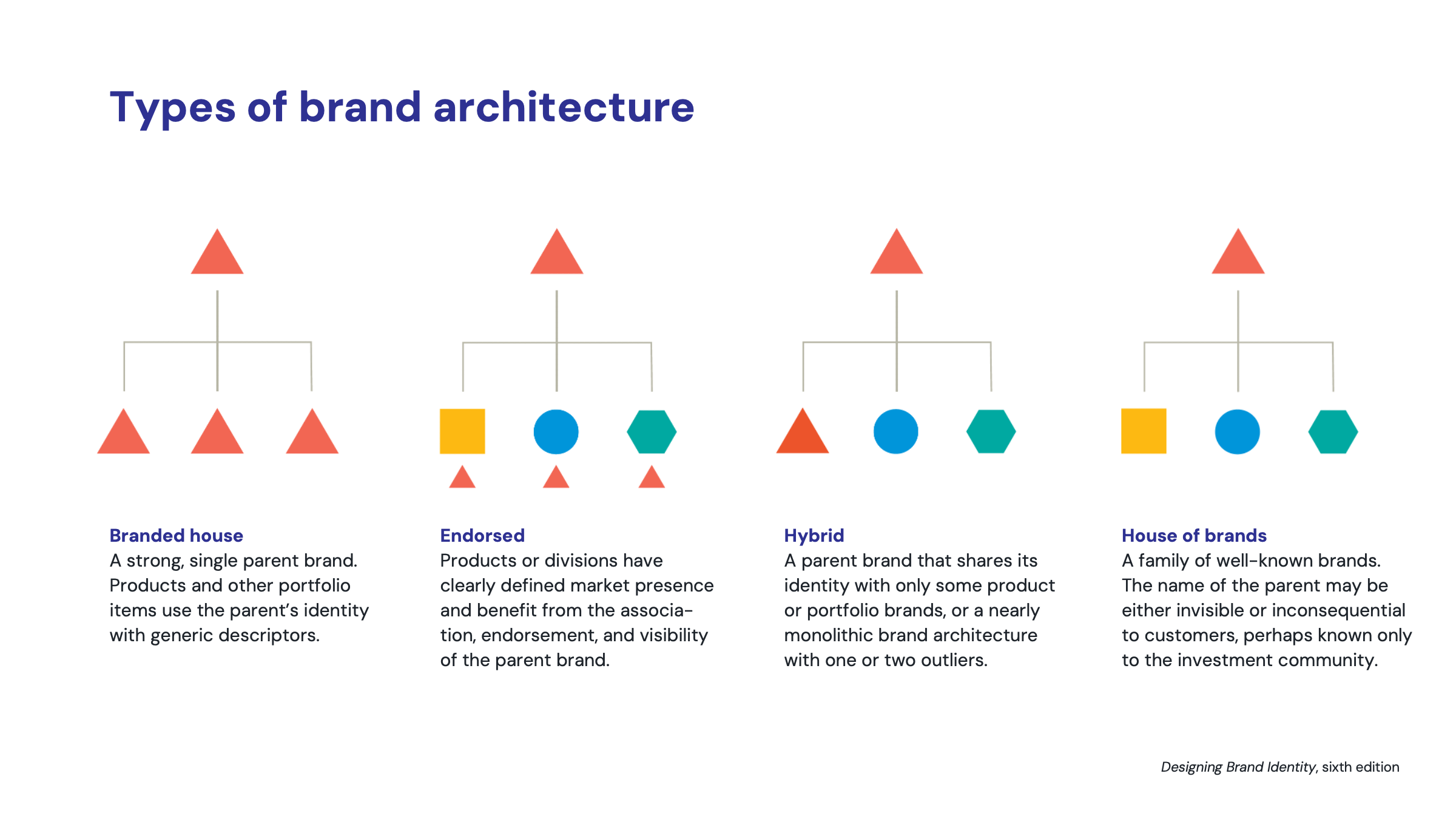
If you've spent any time on the topic, you’ve probably learned the four classic categories: branded house or monolithic, endorsed, hybrid, and house of brands or pluralistic. They’re a useful starting point. But for anyone who’s actually had to sit down and work on architecture in the real world, those four boxes only get you a few steps in. The interesting (and difficult) work begins after you’ve picked one.
This post covers both halves: the framework everyone learns, and the more nuanced questions that determine how your architecture actually works.
What is brand architecture?
Brand architecture defines how a parent company, its subsidiaries, products, services, and acquired brands relate to one another—visually, verbally, and strategically. It clarifies what’s available to customers, makes it easier for them to find what they need, and helps the business market more efficiently across the portfolio.
Brand architecture is not just a Fortune 500 problem. Any organization that’s growing—through acquisition, new product launches, geographic expansion, or brand extensions—will eventually need to think about it.
The four classic types of brand architecture
At the highest level, most brand architectures fall into one of four buckets.
Branded house (monolithic)
A single, dominant parent brand. Products and services use the parent’s identity with descriptive names attached.
Examples: Google, with Google Maps and Google Docs; FedEx, with FedEx Office and FedEx Ground
A branded house concentrates marketing investment behind one name. Every portfolio item reinforces the parent brand, and every parent-brand campaign benefits the products. The tradeoff: less flexibility to position individual offerings differently and more risk if any portfolio item fails to live up to expectations.
Endorsed
Sub-brands have their own identity in the market but are clearly endorsed by, and benefit from the credibility of, the parent.
Examples: Courtyard by Marriott; TurboTax (from Intuit)
Endorsed architectures are useful when you want a sub-brand to feel distinct (different audience, different price point, different category) while still borrowing trust from the parent. The classic “by Parent” lockup tells customers, “this is its own thing, but it’s part of something you already know.”
Hybrid
A portfolio in which some items share an identity with the parent brand while other items are clear outliers; or a portfolio that mixes branded-house, endorsed, and house-of-brand approaches.
Examples: Toyota and Lexus (from Toyota); Coca-Cola, Sprite, and Dasani (from The Coca-Cola Company)
In practice, if you look at almost any large portfolio closely enough, chances are it’s some form of hybrid. Pure branded houses and pure houses of brands are easier to draw on a slide than to maintain over decades of acquisitions, product launches, and category shifts.
House of brands (pluralistic)
A family of well-known brands whose parent is largely invisible to customers and may only be known to investors.
Examples: Dreft and Old Spice (Procter & Gamble); Taco Bell, Pizza Hut, and KFC (Yum! Brands, Inc.)
House-of-brands portfolios let each brand speak directly to its own audience without dragging the parent into every category conversation. The tradeoff is duplication: separate teams, separate budgets, separate brand equity to build and protect. It also means the parent builds very little brand equity with customers.
Why the “houses” aren’t enough
Once you start working on a real architecture project, you’ll quickly realize the four-bucket model is too blunt an instrument. It works well enough for describing brand architecture—it’s relatively unhelpful for doing brand architecture work.
This is the argument I’ve made before on How Brands Are Built: for anyone who has actually had to create, fix, or improve a brand architecture, the oversimplification of the “houses” borders on useless. Choosing branded house vs. house of brands is roughly 5% of the decision. The other 95% includes figuring out organizing principles, naming conventions, and design guidelines that hold the system together.
Beyond the houses: the decisions that really shape your architecture
1. Organizing principles
Organizing principles are the underlying logic that determine how brands and other portfolio items are grouped and arranged in relation to each other. They answer the question, “How do we want customers to navigate the portfolio?”
Common organizing principles include:
Audience or use case: separating offerings by who they’re for or what job they do (consumer vs. enterprise; clinician vs. patient)
Category or industry: grouping by what the offering is or where it competes
Geography: when regional differences in regulation, distribution, or culture justify distinct brands
Product family or platform: when offerings share a technology, process, or design system that customers recognize
A portfolio can have a primary organizing principle with one or two additional principles layered beneath it. The best organizing principles tend to start with the customer, not the org chart, website organization, or corporate structure.
2. Verbal identity
The primary impact of brand architecture on verbal identity is in naming systems. The decision of what to call a new feature, product, or division is often where brand architecture becomes “visible.”
Naming systems questions include:
What’s the standard pattern for naming a sub-brand (e.g., “[Parent] + [Descriptor],” or a fully independent name)? When, if ever, do we break that pattern?
How do we handle acquired brands? Do they keep their names? Do we assimilate them into the parent brand? Over what timespan?
What about ingredient brands, co-branding, partnerships, and feature names?
Brand architecture often becomes messy when names are developed in silos—across marketing, product, and other divisions—without a centralized system or oversight. You might be surprised by how many large, mature organizations have no single “source of truth” for all the names they use. For more on how to think about the logic governing names throughout a portfolio, refer to our Indigo Paper, The Four-by-Four Framework for Naming Systems.
3. Visual identity
The visual identities of brands and other items in a portfolio define a visual architecture—how logos, colors, typography, and other visual identity elements relate to each other.
Key visual architecture decisions include:
What gets a logo and what doesn’t
Whether/how the parent brand’s visual identity shows up in sub-brands
Whether sub-brands share common visual elements
How acquired brands are visually migrated over time (or whether they are at all)
Try lining up logos, packaging, and other visual identity elements for your portfolio items. Can you tell how they relate to each other? Is there a clear hierarchy—do important things look more important, and vice versa? Does everything look too similar or, maybe worse, wildly different? Regardless of which “house” your architecture follows, viewing your portfolio this way can help diagnose under-the-radar brand architecture problems.
How a real project comes together
When Heirloom takes on a brand architecture engagement, the work usually moves through five stages:
Map the existing architecture: What brands, sub-brands, product names, and feature names exist today? How are they organized, and how do customers actually encounter them?
Research: A mix of stakeholder interviews, customer research (qualitative or quantitative), and category benchmarking. The goal is to understand what the portfolio is supposed to do and where it’s currently falling short.
Develop options: We typically explore multiple architecture options before recommending one. Options might differ in terms of organizing principles, groupings and hierarchies, visual and verbal systems, or treatments of acquired brands.
Stress-test and refine: Pressure-test each option against business goals, growth plans, customer needs, and edge cases (the next acquisition, the next product launch, the next geographical expansion).
Recommend and document: A clear recommendation, plus the rules and decision frameworks the company will need to maintain the architecture as it grows.
Not too long ago, we worked with a Fortune 100 industrial manufacturer—a globally recognized name in agricultural, construction, and forestry equipment with more than 150 years of history—on a comprehensive brand architecture project. The portfolio had grown faster than the rules holding it together: dozens of acquired and homegrown sub-brands across agriculture, construction, and financial services, each with its own logo, name, and visual identity. Our recommendations included consolidating brands, eliminating standalone logos for some sub-brands, and migrating select acquired brands to an endorsed model—a “[Brand] by [Parent]” lockup that preserved sub-brand equity while strengthening the parent brand. Several years later, many of those recommendations are in market: previously standalone brands now operate as endorsed sub-brands, and several legacy brands have been retired. The result is a cleaner, more navigable portfolio and a stronger parent brand.
The “houses” are fine for describing a brand architecture. But organizing principles, naming systems, and visual identity are how you build one. And clear guidelines and decision frameworks are how you keep it from becoming a junk drawer all over again.
Have a brand architecture challenge? Get in touch.