Using AI to name your company or product: what works and what doesn’t in 2026
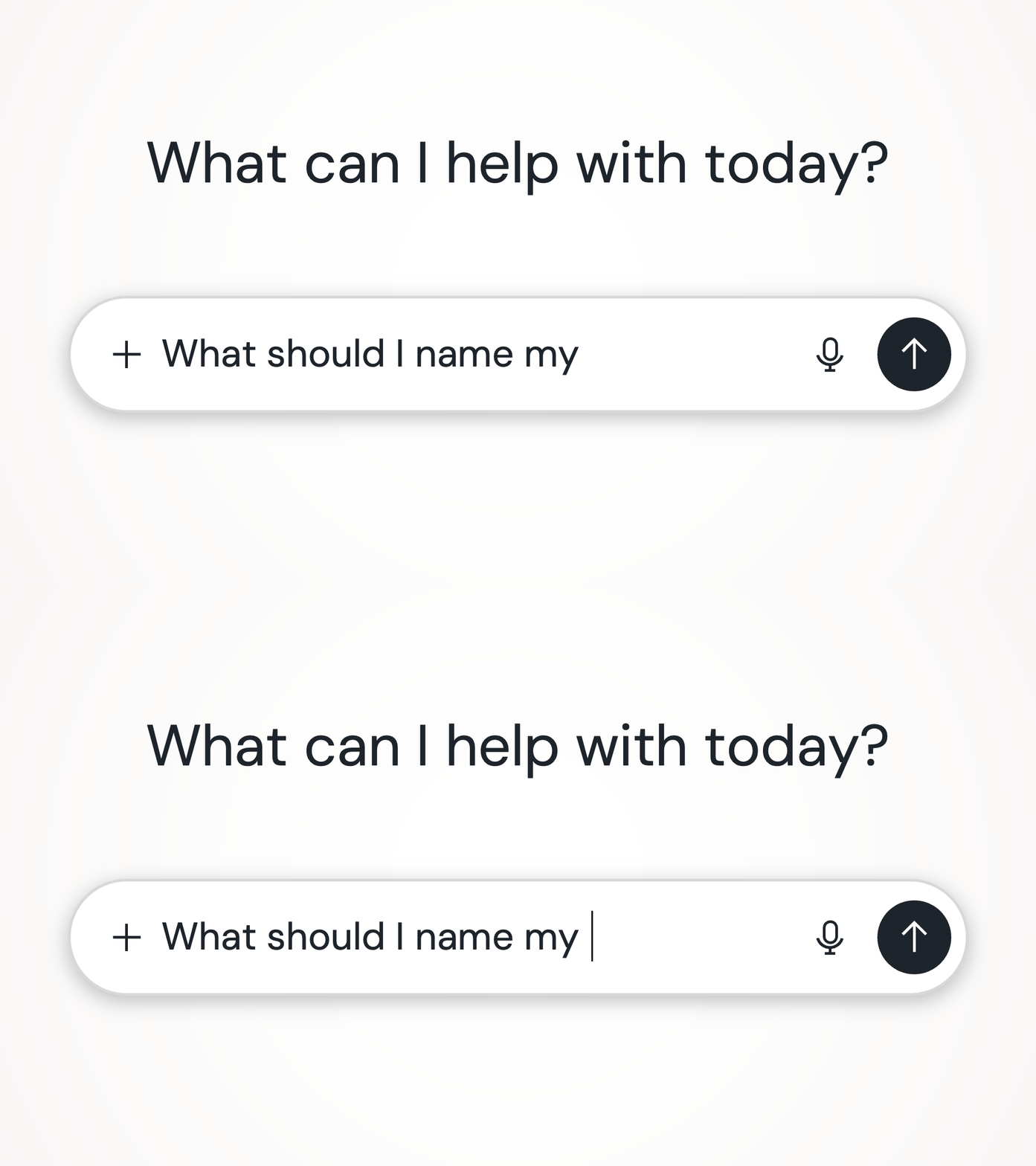
Look, I get it: AI is too cheap, fast, and easy to not try using it to name your company or product. But if you’ve already tried prompts like “What should I call my company?” you’ve probably been disappointed by the results. Unfortunately, while LLMs like ChatGPT, Google Gemini, and Claude can help with naming, they’re not the ultimate shortcut we’d all like them to be.
That’s partly because your company or product name doesn’t just need to be catchy, creative, or cool—it should also be distinctive, adaptable, and legally available for use. To find that name, you need more than a long list of ideas—you need a process that includes some careful thinking at the beginning and some careful vetting at the end. AI can help, but it’s not an all-in-one solution.
In this article, I’ll walk through a rigorous, step-by-step process for brand naming—the same naming process we use at Heirloom—and share where and how AI chatbots can be most useful along the way. AI tools are getting better every day, however; I’ll write an updated version of this article if the situation changes significantly.
01. Develop a naming brief
This is one place that AI really shines: contributing to the front-end research and strategic thinking that goes into a naming brief. Before any ideas are generated by humans or machines, you should have a sense of what kinds of names will work. To get there, try using AI to help you answer questions like:
What are prospective customers looking for from a company/product like ours?
What’s distinctive or unique about our company/product versus others our customers could choose?
What names are competitors using? Are there names or naming styles that are overused in the industry/region?
While AI-enabled answers to these questions won’t necessarily replace more robust market research or a full brand strategy process, they can give you a big head start on a naming brief.
02. Generate a lot of name ideas
Yes, AI tools like ChatGPT and Claude can instantly produce long lists of name ideas, and using the naming brief to narrow the generation will help ensure a more targeted list. But today, AI is only mediocre at coming up with good name ideas. Its raw power is indisputable. Its taste is less impressive.
Rather than simply asking AI for name ideas, use it to help you brainstorm ways of conveying important themes from the brief. Once you’ve decided on some ways you’d like to look for names, ask AI to help with specific tasks. For example:
If you’re naming a café and like the idea of a name related to the coffee-making process, ask ChatGPT to describe that process in detail or give you a long list of words related to it.
If meaning is less important and you simply want an abstract, coined name, try a prompt like “Create a list of pronounceable 5–6-letter strings that begin with a voiceless plosive and have no inherent meaning in English.”
If you want your landscaping service to be seen as fast and reliable, ask Claude to give you a list of things (animals, vehicles, etc.) known for both qualities.
On its own, AI probably won’t create the long list of good ideas that you’ll ultimately need (because so many ideas will be knocked out in preliminary trademark screening, below). But it can certainly play a helping hand and speed up parts of the process.
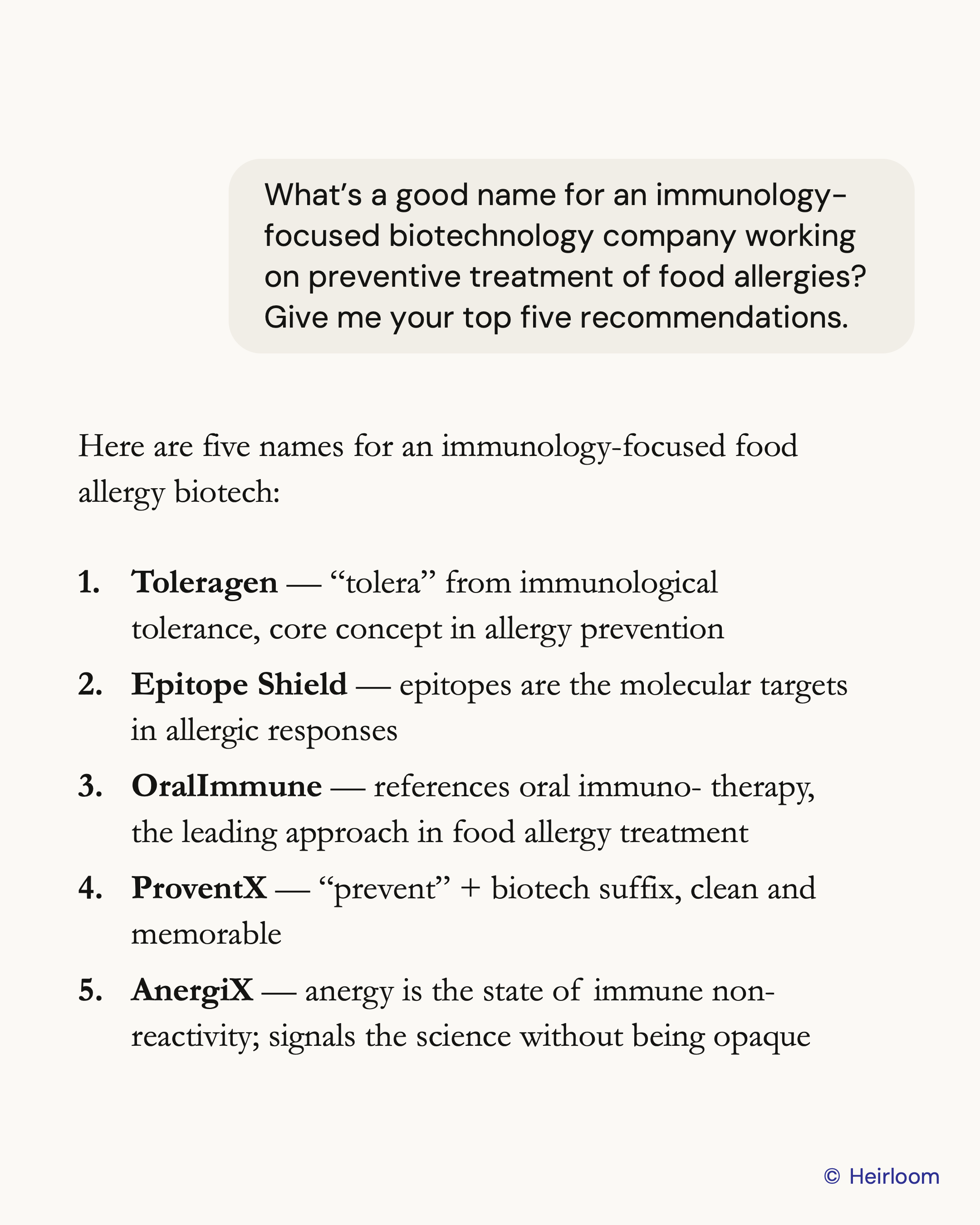
When asked directly for name ideas, AI tools often produce generic, clunky, or otherwise problematic ideas.
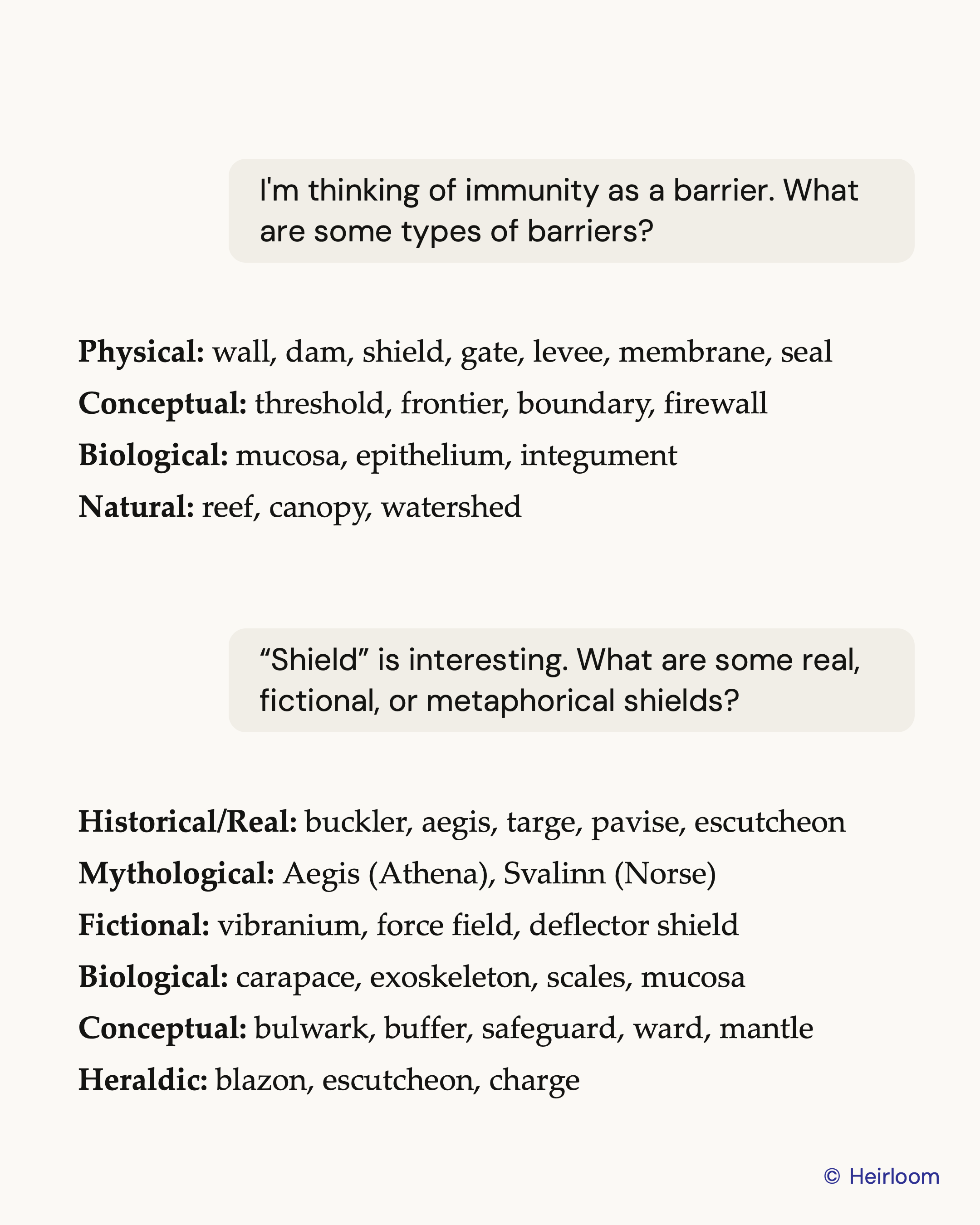
When using generative AI to explore concepts related to the brief, however, more interesting ideas begin to emerge.
03. Shortlisting and screening
AI can help with shortlisting—the process of deciding which names to submit to preliminary trademark screening and linguistic checks. How much it can help with those screening steps, however, is up for debate.
Shortlisting
In my book Brand Naming, I wrote that “shortlisting is best played as a team sport—two or more namers should discuss the ideas, and it’s sometimes useful to get some outside perspective from someone who didn’t help generate names.” An LLM like ChatGPT, Perplexity, or Microsoft Copilot could conceivably provide that outside perspective. Rather than asking which names the chatbot “likes,” however, try asking it to create a table with pros and cons for each name.
Preliminary trademark screening
Once names have been shortlisted, it’s time to submit them to a “knockout” search to see whether they’re being used for identical or similar goods and services. Can AI help? Maybe, but once again, it’s far from a silver bullet.
For years, I’ve been hearing of AI tools that claim to streamline preliminary trademark checks. I’ve sat through product walkthroughs and company pitches. Friends and colleagues have told me they’re successfully using LLMs to review the first three pages of Google results. And I’ve sparred with Claude’s agentic tools for hours trying to get them to do a simple search on the US Patent and Trademark Office’s trademark database.
So far, I just don’t buy it.
Everything I’ve seen is lacking in a simple, foundational way: it can’t be trusted. As many lawyers are learning the hard way, generative AI makes stuff up. And if a human has to double check everything the AI says, I’m not sure it’s saving much time. There may be ways to get creative, however. For example, ask the LLM to search online for potential conflicts and produce a table with results in one column and relevant links in another. That way, double checking its work is easier and faster.
Linguistic disaster checks
Similar to preliminary trademark screening, I’m not sure I’m ready to trust AI with this task. In my experience, linguistic checks rarely uncover major problems. But when they do, you want to be sure.
“For years, I’ve been hearing of AI tools that claim to streamline preliminary trademark checks. So far, I just don’t buy it.”
04. Presentation
Believe it or not, this is another step where AI can play a significant role. While I don’t recommend having it give the presentation on your behalf (yet), it can certainly help you build the slides.
AI tools can help you think through how to best present each idea. They can produce explanations and articulate rationale that may not have occurred to you. Vibe-coded and agentic tools can instantly turn a spreadsheet full of names and rationale points into a series of presentable slides. This is one area where AI immediately proves its worth.
05. Full legal search
Beyond what I’ve written above about preliminary trademark screening, I’ll let the trademark attorneys weigh in on whether and how AI is helping with this step.
06. Final decision
Chatbots are getting better and better at mimicking humans in collaborative settings. I wouldn’t be surprised if AI agents are soon able to play the role of moderator in helping teams reach alignment and make difficult decisions. So far, however, I haven’t seen it done. Furthermore, I’m not sure my human clients are ready to let an AI tool guide them to a decision.
For now, I think it’s mostly up to humans—consultants and clients—to make the final decision based on factors ranging from legal opinions to marketplace distinctiveness.
Can you use AI to name your company or product?
Yes—but not the way you’re probably hoping. AI won’t hand you a great name. What it can do is make a rigorous naming process faster and easier at several key steps: building a brief, finding naming inspiration, shortlisting, and building a presentation. And it’s only getting more helpful every day.
What AI can’t yet do is replace the judgment calls that make naming hard in the first place—knowing a good name when you see one, vetting it thoroughly, and getting a room full of stakeholders to align behind it. Those steps still require human qualities that AI hasn’t mastered: taste, experience, and political savvy.
Right now, use AI as a capable collaborator, not a shortcut. The process hasn’t changed significantly; the same challenges still exist. AI just helps you work through them faster.
Ready to name something?
If you’re exploring the process of naming a business, product, service, initiative, or something else—and want a strong, strategic partner—we’d love to talk. Get in touch.
This post was originally published on How Brands Are Built.